
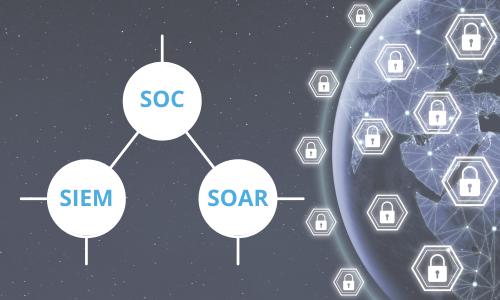
What is a Security Operations Center (SOC)?
A Security Operations Center (SOC) is a centralised team of security analysts who use a range of technologies to continuously monitor network activity, system logs and user behaviour for signs of compromise. Operating 24/7, a SOC investigates alerts, separates genuine threats from noise, and coordinates the response when something goes wrong.
Building this in-house is out of reach for most organisations: SOC analysts are scarce, expensive, and hard to retain around the clock. This is why many organisations turn to a managed detection and response (MDR) service, where an external Security Operations Center handles these functions on their behalf.
What is SIEM and how does it support a SOC?
Security Information and Event Management (SIEM) is the technology that underpins most SOCs. A SIEM platform collects, aggregates and analyses logs from across an organisation’s security tools, comparing events against predefined rules to flag potential threats or anomalies, from distributed denial-of-service (DDoS) attacks and suspicious login attempts to phishing, code injection and ransomware indicators.
SIEM is powerful, but it is not autonomous: it still needs skilled analysts to interpret the alerts, investigate what matters, and decide what to do next. Without that expertise, a SIEM’s output is just noise, which is exactly why SIEM and SOC are usually discussed together, and rarely deliver value in isolation.
What is SOAR, and how is it different from SIEM?
Security Orchestration, Automation and Response (SOAR) is a category of tools that goes a step further than SIEM. Where SIEM centralises and correlates data to generate alerts for a human to investigate, SOAR uses predefined playbooks, often reinforced with artificial intelligence, to take action automatically, such as isolating an infected endpoint or blocking malicious traffic.
The benefits organisations look for in SOAR are consistent:
- Speed: reducing mean time to detect (MTTD) and mean time to restore (MTTR).
- Automated response: playbooks trigger a consistent, pre-approved reaction to known incident types.
- Context: SOAR draws on multiple data sources at once, giving analysts a fuller picture of an incident, faster.
SOAR is sometimes framed as a replacement for SIEM. In practice, it is more accurate to see it as a complement: SIEM centralises and correlates the data; SOAR automates what happens next.
SOC, SIEM and SOAR: how the three come together
SOC, SIEM and SOAR answer three different questions:
- SOC: who is watching, 24/7?
- SIEM: where does the data come from, and what does it mean?
- SOAR: what happens automatically once a threat is confirmed?
A SIEM generates the alerts; a SOAR platform can act on some of them automatically; and it is the SOC, the human team, that manages the whole process, decides what needs deeper investigation, and takes responsibility for the outcome. None of the three replaces the others: a SOC without SIEM has poor visibility, a SIEM without a SOC produces alerts nobody reviews, and SOAR without a SOC to supervise it risks automating the wrong response.
Why detection and response matters for NIS2 and other compliance obligations
Continuous monitoring and incident detection are not just good practice. Under NIS2, in-scope organisations in the EU are expected to have processes in place to detect and handle incidents, and to report significant ones within tight deadlines. A documented SOC, SIEM and SOAR set-up, whether run in-house or through an MDR provider, is one of the clearest ways to demonstrate that this obligation is met.
Why most organisations run SOC, SIEM and SOAR through an MDR service, not in-house
Running SOC, SIEM and SOAR in-house means paying for 24/7 staffing, specialised tooling, and continuous tuning, a cost and skills burden few organisations, outside the largest enterprises, can justify. This is why managed detection and response (MDR) has become the default model: an external provider operates the SOC, SIEM and SOAR stack on the client’s behalf, under monitoring and escalation commitments defined in the service agreement.
Approach Cyber delivers this through Continuous Operations, combining a 24/7 Security Operations Center with SIEM-driven detection and SOAR-style automated response, on the sovereign AXS Guard platform.
Not sure whether your organisation needs a SOC, or whether outsourcing detection and response makes more sense for your team? Talk to one of our security experts to assess your current setup.
Frequently asked questions
What is the difference between SOC, SIEM and SOAR?
A SOC is the team, SIEM is the technology that centralises and analyses security data, and SOAR is the technology that automates the response. A SOC typically uses both SIEM and SOAR to do its job.
Do I need a SIEM if I already use SOAR?
Yes. In most set-ups, SOAR relies on SIEM, or an equivalent data source, to know what to respond to. They are complementary, not substitutes.
What is managed detection and response (MDR)?
MDR is a service where an external provider runs SOC, SIEM and SOAR functions on your behalf, so you get 24/7 monitoring and response without building the capability in-house.
Can a small or mid-sized organisation benefit from MDR?
Yes. MDR was designed for organisations that cannot justify a full in-house SOC, and it is one of the most common ways smaller security teams get 24/7 coverage
Do you have questions or want more info?
» Contact us